

Classical Mechanics and Applied Mathematics: Methods, Problems, Solutions
A small green notebook at the Niels Bohr Library & Archives in College Park, Maryland contains handwritten notes made by Richard Feynman as a teenager in the early 1930s. He was about 13. The book he was working through was Calculus for the Practical Man by J.E. Thompson, first published in 1931. His high school did not teach calculus, trigonometry was the ceiling. He got the book from the library and worked through it alone, inventing his own notation for functions he found confusing. His father could not follow what Feynman was doing. Feynman recalled later that this was the first time he understood something that his father could not.
Thompson designed the series for readers without an instructor. The preface says so directly: the books are for those who wish to obtain practical mastery of mathematics “without the aid of a teacher.” Thompson used rates and physical examples where formal treatments use limits and epsilon-delta proofs. The Feynman Lectures on Physics, available at feynmanlectures.caltech.edu, run on the same principle: physical intuition before formal abstraction.
Newton’s Laws Under Non-Ideal Conditions
Newton’s second law is commonly written F = ma. This is not the full form. The complete statement is F = dp/dt – force equals the rate of change of momentum. For constant mass, dp/dt reduces to m·a. The simplified form is correct in most engineering applications. Variable-mass problems are the exception.
Variable Mass and the Rocket Equation
A rocket accelerates by ejecting mass at high velocity. As fuel burns, mass decreases continuously. Applying F = ma to this system gives the wrong answer. The full momentum form yields the Tsiolkovsky rocket equation: Δv = vₐ·ln(m₀/m₆). The logarithm comes directly from integrating dp/dt with time-varying mass. It is not accessible from F = ma.
Non-Inertial Frames, Friction, and Air Resistance
Newton’s laws hold in inertial frames, those not themselves accelerating. A rotating frame introduces fictitious forces: the Coriolis force, the centrifugal force, the Euler force. These are artefacts of the frame, not interactions between objects, but they affect trajectories. Weather patterns rotate because the Earth is a rotating frame. Ballistic corrections for the Coriolis effect are not negligible.
Most textbook problems also assume frictionless surfaces, massless strings, and negligible air resistance. Air resistance scales with the square of velocity in turbulent flow; kinetic friction becomes velocity-dependent at higher speeds. The simplifications are necessary for pedagogy. But the gap between problem-set mechanics and physical reality is larger than the exercises suggest.
Why Problem Sets Work – and When They Don’t
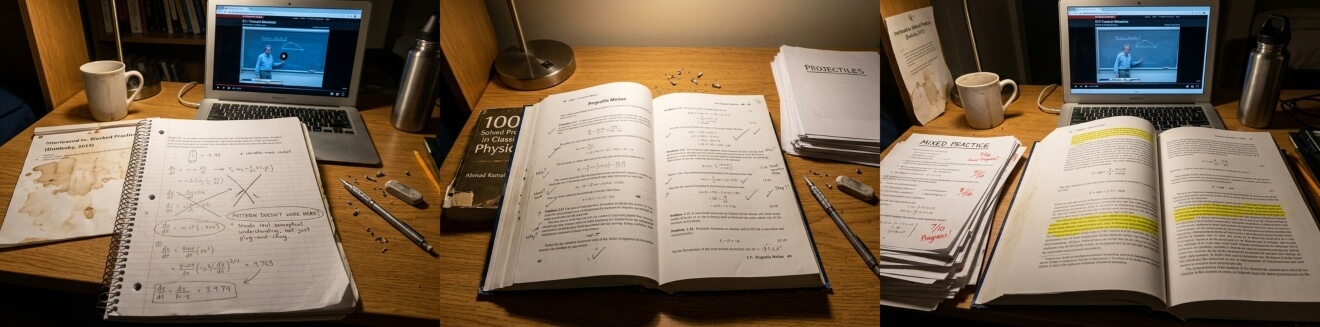
Procedural practice builds fluency – the ability to execute a technique without reconstructing it from first principles each time. A student who has solved a hundred projectile problems can parse a new one quickly. But fluency and understanding are different things. A student can solve F = ma problems by pattern-matching without understanding what force, mass, or acceleration mean physically. The gap shows when the form changes or a variable-mass case appears.
1000 Solved Problems in Classical Physics by Ahmad A. Kamal (Springer, 2011) covers mechanics, oscillations, waves, optics, and thermodynamics at undergraduate level. Solutions are fully worked out. What the book does not discuss, and does not claim to, is where the solutions fail at the edges of Newtonian assumptions. Fluency gained from it is real. Whether boundary awareness develops depends on what is read alongside it.
Research on interleaved versus blocked practice is relevant. Blocked practice, twenty problems of the same type before moving on, builds speed on that type but produces lower retention and worse transfer than interleaved practice, where types are mixed. Most solved-problem books use blocked organization by necessity. Worth knowing when using them.
The Sequence Thompson Used
J.E. Thompson’s series, published by Van Nostrand through the 1920s and 1930s, ran in a fixed order. Each volume introduced the next mathematical layer by grounding it in rates, areas, and physical quantities rather than axiomatic definitions.
Book | Core method | What it builds |
|---|---|---|
Arithmetic for the Practical Man | Counting, fractions, ratios | Number intuition |
Algebra for the Practical Man | Equations, symbols as quantities | Symbolic reasoning |
Trigonometry for the Practical Man | Angles, periodic functions | Geometric intuition |
Calculus for the Practical Man | Rates, not limits | Change as a physical concept |
Modern calculus curricula in North America often start with the epsilon-delta definition of a limit, rigorous but abstract for students who have not yet encountered the physical situations the definition is designed to formalize. The sequence is logically correct; for many learners it is pedagogically backwards. Retention studies comparing intuition-first and formalism-first approaches have not settled the question. The evidence favors intuition-first for initial acquisition. Long-term retention of formal reasoning is less clear.
Feynman cited Thompson’s epigraph in a 1979 interview in Omni magazine: “I had a calculus book once that said, ‘What one fool can do, another can.’” His point was about mathematics as a human activity, not a gated discipline. The notebook from his teenage study of Thompson is preserved. It is one of the more concrete pieces of evidence that self-directed study from a well-written book can produce a physicist.
Oscillations and the Equations That Recur
Simple harmonic motion is described by d²x/dt² + ω²x = 0. An LC electrical circuit, an inductor and capacitor in series, is governed by d²Q/dt² + Q/(LC) = 0. The two equations are mathematically identical. Every result derived for the spring-mass system – resonance, damping, driven oscillations – translates directly to the LC circuit by substituting variables. This is not an analogy in the loose sense; it is a formal equivalence.
Quantity | Spring–mass system | LC circuit |
|---|---|---|
Displacement | Position x | Charge Q |
Velocity | v = dx/dt | Current I = dQ/dt |
Inertia | Mass m | Inductance L |
Restoring factor | Spring constant k | 1/Capacitance (1/C) |
Angular frequency | ω = √(k/m) | ω = 1/√(LC) |
Equation of motion | d²x/dt² + (k/m)x = 0 | d²Q/dt² + Q/(LC) = 0 |
The same second-order equation governs the torsional vibration of a drive shaft, acoustic resonance, a pendulum at small angles, and the quantum harmonic oscillator. Learning it once, in the mechanical context where physical intuition is strongest, provides the framework for every subsequent encounter.
Energy conservation is sometimes a faster route than solving the equation of motion. For an undamped spring-mass system, E = ½mv² + ½kx² is constant. Maximum displacement occurs when velocity is zero; maximum velocity when displacement is zero. These follow from conservation alone, without differential equations.
What Classical Mechanics Cannot Model
The Newtonian framework has three well-defined boundaries. At the first two, a different framework takes over. At the third, the classical framework itself produces unpredictability without any external mechanism.
Regime | What classical mechanics misses | Replacement framework |
|---|---|---|
Velocities approaching c | Momentum is not linear in v; time is not absolute | Special relativity |
Atomic / subatomic scale | Position and momentum cannot both be exact; energy is quantised | Quantum mechanics |
Chaotic systems | Tiny differences in initial conditions diverge exponentially | No replacement – determinism doesn’t yield predictability |
None of this diminishes classical mechanics. Structures, machines, vehicles, fluids, acoustics – all are classical problems that do not require relativistic or quantum corrections. The boundaries are worth knowing because they define the scope of the framework, not because they limit its practical utility within that scope.