
Pharmacology in Clinical Nursing: Drug Classes, Safety Margins, and Practice
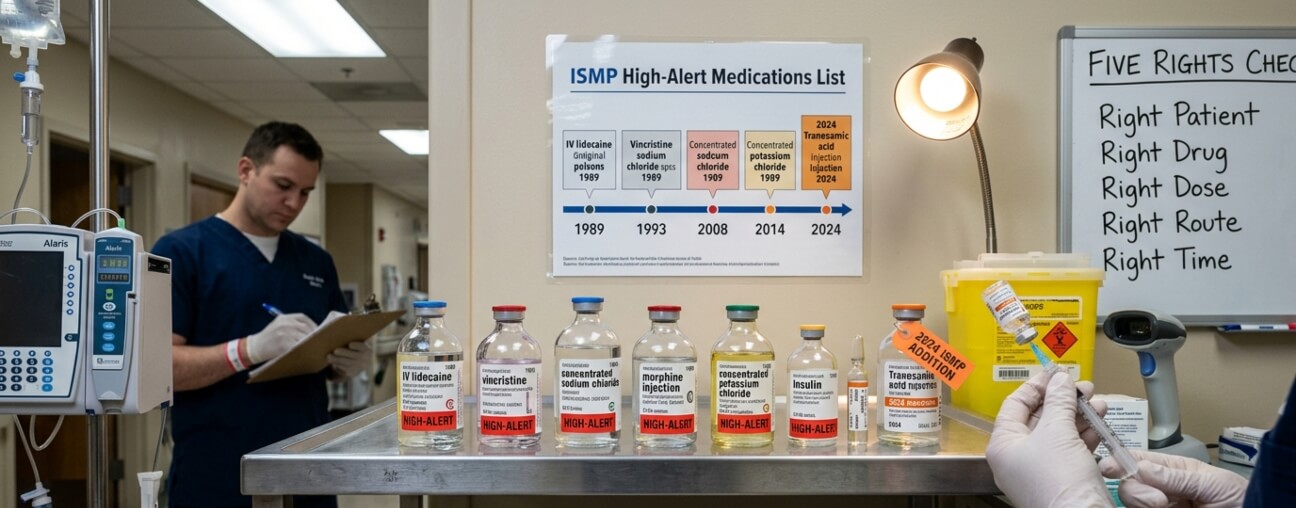
In 1989, a short article in the journal Nursing identified six drugs as requiring special safeguards. The authors called them “today’s poisons.” The list included IV lidocaine, vincristine, concentrated sodium chloride, morphine injection, concentrated potassium chloride, and insulin. The Institute for Safe Medication Practices has updated and expanded that list four times since. The 2024 edition added tranexamic acid injection. All six original entries are still on it.
High-alert medications are not necessarily the drugs most commonly involved in errors. They are the drugs for which an error, when it occurs, is most likely to cause severe or fatal harm. That distinction matters for how nurses think about verification. The question is not which drugs require care, but which drugs require a different level of system-based safeguards.
How Drugs Move Through the Body, and Why the Route Matters
Pharmacokinetics describes what the body does to a drug: how it is absorbed, distributed to tissues, metabolized, and excreted. The abbreviation ADME captures the four stages. Each stage creates a variable, and variables multiply across patients with different weights, ages, renal function, liver enzyme activity, and concurrent medications.
The route of administration determines how much of a dose reaches systemic circulation. Oral bioavailability varies considerably between drugs. Oral morphine, for example, has a bioavailability of roughly 20–35%, depending on the patient. The same drug administered intravenously reaches essentially 100% bioavailability. The numbers look like a simple conversion: divide the IV dose by 0.3, and you have the oral equivalent, but the calculation is not that straightforward in practice. Renal function, opioid tolerance, body weight, and the presence of other CNS depressants all shift the ratio. The bioavailability figure is a population average; any individual patient may sit well outside it.
Distribution describes how a drug moves from the bloodstream into tissues. Lipid-soluble drugs cross cell membranes readily and distribute widely, including into the central nervous system. Water-soluble drugs remain largely in the extracellular compartment. This matters for drug interactions: two highly protein-bound drugs competing for plasma proteins can displace each other, raising free drug concentrations without any change in dose.
Metabolism occurs primarily in the liver, where cytochrome P450 enzymes convert drugs into forms that can be excreted. Genetic variation in CYP450 expression means that the same dose of a drug can produce different plasma levels in different patients – a fact that conventional dosing guidelines, built around population medians, can only partially accommodate. Excretion, primarily renal, is the reason kidney function is checked before prescribing or adjusting doses of drugs like lithium, gentamicin, or metformin.
Drug Classes and the Mechanisms They Target
Drugs work by modifying biological processes, not by creating effects that the body cannot produce on its own. Understanding the mechanism behind a drug class is more durable knowledge than memorizing a list of names, because new drugs within a class typically share the same mechanism and therefore the same profile of effects and risks.
Receptor Agonists and Antagonists
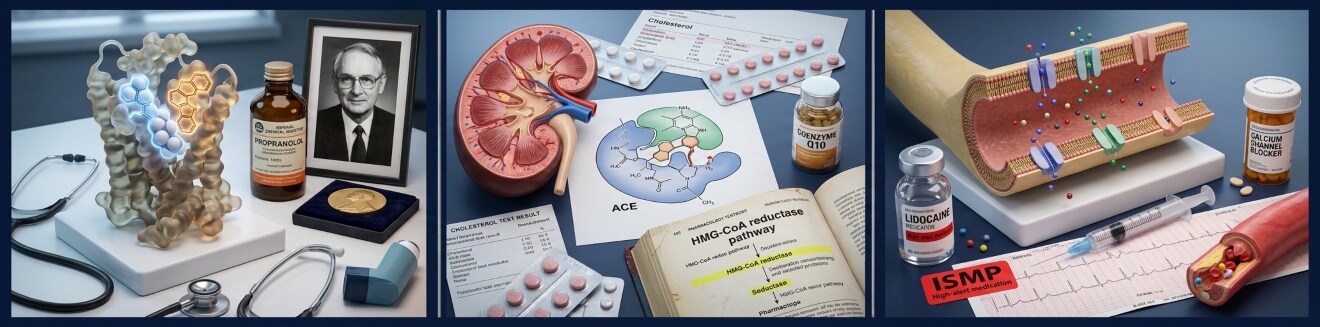
Receptor agonists bind to a receptor and activate it. Receptor antagonists bind to the same site and block it. Beta-adrenergic agonists (such as salbutamol) activate beta receptors in the airway smooth muscle, causing bronchodilation. Beta-adrenergic antagonists, beta-blockers, block those same receptors, reducing heart rate and myocardial oxygen demand.
James Black developed the first commercially viable beta-blocker, propranolol, in the early 1960s at Imperial Chemical Industries. His explicit goal was to treat angina – reduce the heart’s oxygen demand, reduce chest pain. He was awarded the Nobel Prize in Physiology or Medicine in 1988. At the time of propranolol’s development, no one was thinking about performance anxiety or essential tremor. The drug’s utility in anxiety disorders, migraine prevention, and thyrotoxicosis emerged from clinical observation over subsequent decades. This is common in pharmacology – mechanisms are narrow, but their downstream effects are not always predictable from the original hypothesis.
Enzyme Inhibitors
Enzyme inhibitors reduce the activity of a specific enzyme. ACE inhibitors block angiotensin-converting enzyme, reducing the production of angiotensin II and lowering blood pressure. Statins inhibit HMG-CoA reductase, the rate-limiting enzyme in cholesterol synthesis. Knowing which enzyme is targeted explains why a drug works and why it produces the side effects it does – statins cause myopathy in a small percentage of patients partly because the same enzyme pathway is involved in coenzyme Q10 synthesis.
Ion Channel Blockers
Ion channel blockers alter the movement of charged particles across cell membranes. Calcium channel blockers slow the influx of calcium into cardiac and smooth muscle cells, reducing heart rate and vasodilating peripheral arteries. Local anaesthetics block sodium channels in nerve fibres, preventing the propagation of action potentials. The same mechanism that makes lidocaine useful as a local anaesthetic makes it dangerous at systemic doses, which is why IV lidocaine appears on the ISMP high-alert medication list.
The Margin Between Therapeutic and Toxic
The therapeutic index is the ratio between the dose that causes toxicity and the dose that produces the desired therapeutic effect. A wide therapeutic index means there is substantial room between a dose that works and a dose that harms. A narrow therapeutic index means that the margin is small, often no larger than the normal variation in a patient’s physiology.
Four drugs come up consistently in discussions of narrow therapeutic index: warfarin, digoxin, lithium, and phenytoin. Each requires a different type of attention. Warfarin’s anticoagulant effect is sensitive to diet, enzyme-inducing medications, and genetic variation in CYP2C9 and VKORC1. Digoxin’s toxicity threshold is close to its therapeutic level and is further reduced by hypokalaemia, a complication that may itself result from concurrent diuretic therapy. Lithium clearance is almost entirely renal; any condition that reduces glomerular filtration – dehydration, NSAIDs, renal deterioration – can raise lithium levels into the toxic range within days. Phenytoin has non-linear pharmacokinetics: at low doses, a dose increase produces a proportional increase in plasma levels; near saturation of the metabolic enzymes, the same dose increment produces a disproportionately large rise.
Plasma monitoring for narrow therapeutic index drugs is standard practice in principle. In practice, monitoring frequency varies significantly across institutions and clinical settings. Studies examining real-world monitoring of drugs like lithium and digoxin consistently find that testing intervals are longer in community settings than guidelines recommend, and that dose adjustments do not always follow elevated levels. This is not unique to any one jurisdiction. It reflects the gap between what protocols specify and what routine clinical workload permits.
This is not unique to any one jurisdiction. It reflects the gap between what protocols specify and what routine clinical workload permits.
Nurses’ drug handbooks – the McGraw-Hill, Lippincott, and Saunders editions being the most widely used in North American clinical settings – provide point-of-care dose ranges, renal dose adjustments, and monitoring parameters for narrow therapeutic index drugs. They are reference tools, not substitutes for pharmacokinetic reasoning. A handbook entry for lithium states the therapeutic range; it cannot account for the individual patient’s GFR trajectory over the previous 72 hours, or for the diuretic that was added to the regimen three days before the level was drawn.
High-Alert Medications: Where Most Errors Occur
ISMP’s high-alert medication list classifies drugs by the severity of harm an error can cause, not by how often errors with those drugs occur. The two measures are related but not identical. Insulin errors, for example, are among the most frequently reported medication errors in acute care. They are also among the most potentially lethal. Concentrated potassium chloride, by contrast, is rarely administered in error, but when it is, the result can be fatal cardiac arrest within minutes.
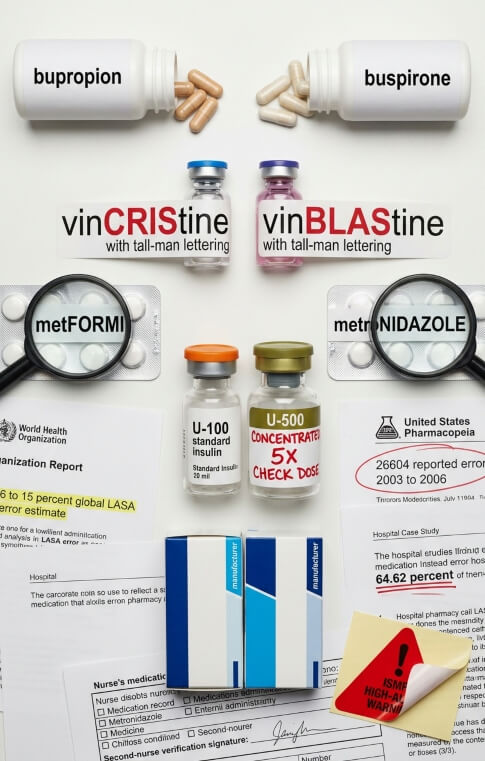
Not all medication errors are dosing errors. Look-alike and sound-alike (LASA) drug names account for a substantial share of reported incidents. The WHO estimates LASA errors represent 6–15% of all medication errors globally; estimates from US-based reporting data reach as high as 25% of medication error events. The US Pharmacopeia recorded 26,604 LASA errors through its spontaneous reporting system between 2003 and 2006 alone. In a 2024 case study of LASA errors in a 200-bed general hospital, drug name confusion accounted for 64.62% of all LASA-type errors identified.
The contributing factors are compounded. Similar-sounding names (bupropion and buspirone; vinCRIStine and vinBLAStine) exist across thousands of drug pairs. Similar packaging between different drugs from the same manufacturer adds a visual layer of confusion. ISMP has addressed this partly through tall-man lettering, the practice of capitalizing distinguishing letters within a drug name (metFORMIN vs. metroNIDAZOLE), but the evidence base on whether tall-man lettering consistently reduces errors remains mixed.
A separate category of errors involves confusion between standard and concentrated formulations of the same drug. Insulin U-500 is five times more concentrated than standard U-100 insulin. ISMP has singled it out within the insulin category for additional safeguards because errors involving it produce overdoses that are not proportional to what a nurse might expect from the volume drawn.
What Verification Protocols Actually Catch
The five rights of medication administration – right patient, right drug, right dose, right route, right time – are taught in every nursing programme. They function as a checklist applied at the point of administration, the last step in a chain of decisions that began with the prescriber.
Judy Smetzer of ISMP described the five rights as “broadly stated goals, or desired outcomes, of safe medication practices that offer no procedural guidance on how to achieve these goals.” That framing is useful. The five rights are not a process; they are criteria for evaluating whether a process succeeded. A nurse who completes all five checks can still administer a drug that is wrong for a patient’s condition if the prescribing decision was based on incomplete clinical information. The five rights catch dispensing and transcription errors. They do not catch knowledge-based errors.
PSNet’s primer on medication administration errors notes that the five rights do not ensure administration safety as a standalone process, and that four additional rights have been proposed – right documentation, right action/reason, right form, and right response. Some institutions have expanded further to ten rights. The expansion reflects an honest recognition: the original five describe what to check, not why the check matters or what to do when the information found is ambiguous. Workload, interruptions, and understaffing reduce adherence to any version of the framework. These are documented, recurring findings across multiple clinical settings and jurisdictions.
System-based safeguards that have shown consistent effectiveness include computerized prescriber order entry (CPOE), pharmacy verification before dispensing, and barcode medication administration (BCMA). Each addresses a different point in the medication-use chain. BCMA, for example, catches discrepancies between what is scanned at the bedside and what is on the medication administration record – errors that would pass all five rights checks without detection. None of these technologies eliminates errors; each shifts where in the process they are most likely to occur and be caught.
The practical implication for clinical practice is that the five rights are necessary but not sufficient. A nurse who understands why a drug is being given, what its mechanism is, and what clinical response would indicate a problem is better positioned to catch an error than one who verifies the five rights without that background knowledge. The pharmacokinetics and drug class framework covered in the earlier sections of this page exists precisely because procedural checks cannot substitute for clinical understanding.