
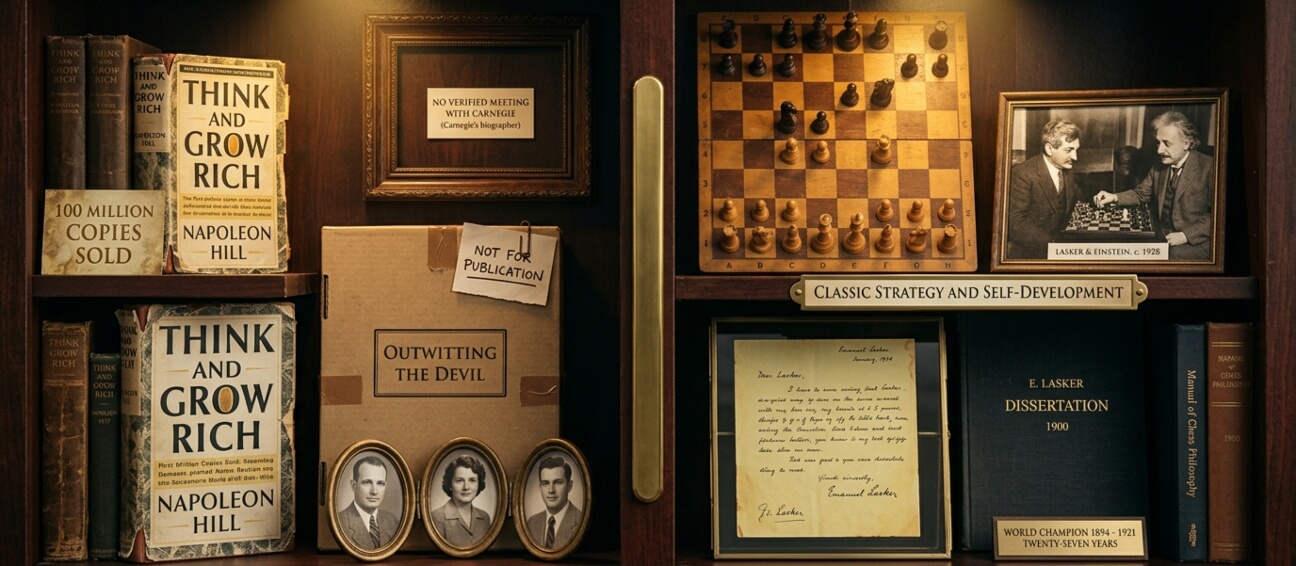
Classic Texts on Self-Development and Strategic Thinking
The numbers first.
73
years Napoleon Hill’s second book sat in a drawer before publication
27
years Emanuel Lasker held the World Chess Championship, longer than any successor
100 M+
copies sold of Hill’s books, across all editions, per the Napoleon Hill Foundation
0
verified meetings between Napoleon Hill and Andrew Carnegie, per Carnegie’s biographer
These are the books that redirected to this page. One was considered too controversial for publication while three successive family members were still alive. The other was written by a man whose relationship with Albert Einstein involved regular correspondence, whose doctorate was in mathematics, and who treated chess as a branch of philosophy. They are not usually discussed in the same room. They belong on the same shelf.
What follows is the history of two specific texts, a description of the genre one of them helped create, and an honest account of what that genre does and does not deliver.
Napoleon Hill and the Origins of Motivational Literature
Napoleon Hill published Think and Grow Rich in March 1937. It was the book that effectively created the modern self-help genre. BusinessWeek ranked it the sixth best-selling paperback business book 70 years after publication. Estimates of total sales exceed 100 million copies. The Napoleon Hill Foundation, established in 1962, still generates revenue from it. By any publishing measure, the book worked.
The backstory it rests on did not. Hill claimed that in 1908 a chance interview with the industrialist Andrew Carnegie resulted in a commission: Carnegie allegedly asked Hill to spend 20 years interviewing the most successful people in America and distil their methods into a formula. This commission became the stated foundation of Hill’s entire body of work.
Carnegie’s biographer David Nasaw stated that he “found no evidence of any sort that Carnegie and Hill ever met.” Hill spent much of 1908 evading authorities over a lumber fraud in Alabama. He only began making the Carnegie claim publicly after Carnegie died in 1919.
— David Nasaw, Carnegie biographer, via Gizmodo (2016) and Wikipedia / Think and Grow Rich
The claim was never independently verified. Carnegie’s personal papers contain no record of the meeting. The Napoleon Hill Foundation maintains that the meeting took place; the 1995 official Hill biography conceded that his book presenting alleged Carnegie conversations was “a somewhat contrived conversational format.” Carnegie’s biographer found it clearly fictional.
Hill was a real author with real readers. He was also a real subject of fraud accusations: in Alabama for the lumber dealings, later for multiple business ventures. The contrast, a self-help author who could not himself demonstrate consistent success by the methods he prescribed, is part of the documentary record, not a rhetorical point.
The follow-up, Outwitting the Devil, was written in 1938, one year after Think and Grow Rich. Hill’s wife Annie Lou decided not to publish it. The book is structured as a claimed interview with the Devil himself; the manuscript attacks churches and schools as instruments of control. Hill introduced two concepts he considered central: “drifters”, people without definite purpose, whom he characterised as susceptible to what he called hypnotic rhythm, and the counter-principle of definiteness of purpose as the mechanism of escape.
After Hill died in 1970, the manuscript passed to Annie Lou. When she died in 1984, it passed to her nephew, who also did not publish it, at his wife Frankie’s request. After Frankie’s death, it passed to Don Green, CEO of the Napoleon Hill Foundation, who had it annotated by Sharon Lechter. It was finally published in June 2011. Three generations of family hesitation did not prevent it from debuting on the bestseller list.
Lasker’s Chess Manual as a Text on Decision Under Pressure

Emanuel Lasker held the World Chess Championship from 1894 to 1921 – 27 years, the longest reign of any officially recognised champion in history. He had a PhD in mathematics from the University of Erlangen-Nürnberg (1902). He corresponded regularly with Albert Einstein. He wrote a philosophical treatise called Struggle (1907), in which he argued that chess was not an isolated pastime but a specimen of a universal human activity.
“The method is plastic,” Lasker wrote in Struggle. “It is applicable in every situation.” He saw chess much the way a game theorist would later: the struggle was with an opponent, not with objectivity, and strategy could be modulated given the specific strengths and weaknesses of the player sitting across the board.
— Lasker, Struggle (1907), cited via chess.com/blog
His Manual of Chess (German edition 1925, English 1927) is unusual in the chess literature for the same reason. It does not treat chess as a set of positions to memorise. It treats it as a study in how to make decisions under competitive pressure, with incomplete information and an opponent who is actively trying to defeat you. The book is divided into six sections, ending with “The Aesthetic Effect in Chess”, a section on what makes a chess solution intellectually satisfying, as distinct from merely technically correct.
Lasker also believed that 200 hours of study was sufficient to master the game to a high level. He stated this directly in the Manual. Modern chess education would dispute the claim, elite players at 2700+ Elo typically have significantly more hours of practice, but the argument behind it is serious: he meant that the principles of good chess are not numerous, and what fails players is not knowledge but application under pressure.
What Made These Books Last
Both Hill and Lasker wrote before the modern publishing industry’s quality-control infrastructure existed. There were no systematic editorial peer-review processes, no independent fact-checking departments, and no mechanisms for correcting factual errors once a book was in print. A book that found a word-of-mouth audience in 1925 or 1937 could persist for decades before any institutional scrutiny reached it.
Lasker’s book survived on the strength of his record. His chess results were independently verifiable; the game scores existed. His ideas about psychological competition were taken seriously because the man had demonstrated them at the highest level for 27 years. That gives the Manual an evidentiary base that is absent from the self-help genre.
Hill’s books survived on different dynamics. Think and Grow Rich was published during the Great Depression. The audience was specific: Americans who had recently experienced the collapse of conventional institutions and were looking for an account of success that did not depend on employers, banks, or inheritance. Hill offered a purely internal theory, thought patterns as the sole determinant of outcomes. The message was calibrated to a moment of institutional failure. It persisted partly because the conditions that made it attractive recur, and partly because it became self-referentially embedded in the self-help industry it created.
Reading the Genre Critically: Claims Without Evidence
The self-help genre, as established by Hill and continued by his successors, makes empirical claims: think in this way and you will achieve these outcomes. This is a testable form of assertion. It has not been tested in a controlled way.
The success cases in motivational books, the people who applied the method and achieved results, are not a representative sample. They are the cases that came to the author’s attention or could be used to illustrate the method. The people who applied the same method and did not achieve the claimed results are invisible in the text. This is selection bias in its most basic form. It is not a subtle problem; it is structural to the genre.
This is worth stating directly because Hill’s books present themselves as research. Think and Grow Rich claims to be the product of 20 years of interviews with 500 successful individuals. The Carnegie commission that supposedly initiated that project was fabricated, per the documentary record. The book is a work of popular philosophy and motivational writing. It should be read as such, not as a dataset.
The Distance Between Advice and Documented Outcome
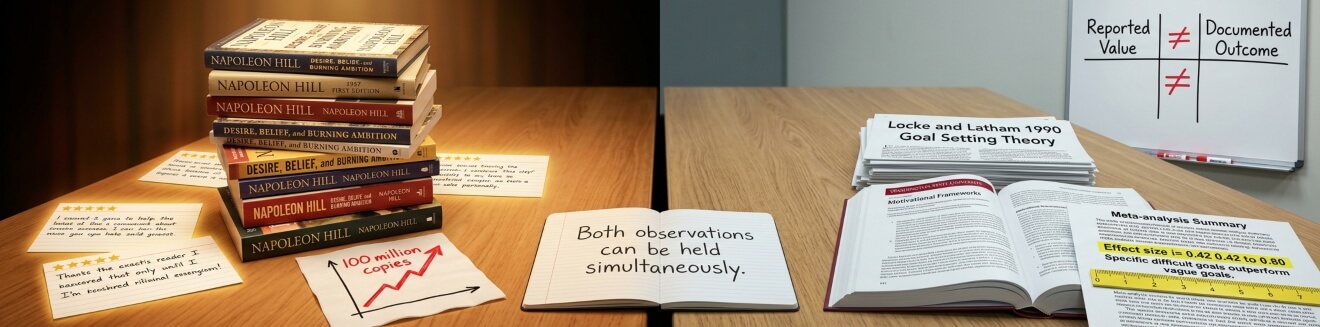
What does the academic literature actually say about motivational reading and goal-setting? The research base is concentrated in occupational psychology, where it is more rigorous than in the self-help genre, and the findings cut in a particular direction.
Edwin Locke and Gary Latham’s research on goal-setting, formalized in 1990 and now considered, in the words of a review in a Washington State University educational psychology textbook, “one of the most influential frameworks in motivational psychology,” produces a consistent finding: specific, difficult goals lead to significantly higher performance than vague ones. Their meta-analyses found effect sizes ranging from .42 to .80.
“Specific and difficult goals lead to a higher level of performance than vague, nonquantitative goals such as ‘do your best,’ ‘work at a moderate pace,’ or no assigned goals.”
— Locke & Latham (1990/2002), summarised in Strategic Management Insight
The vague framing of motivational self-help, “desire,” “belief,” “burning ambition”, is precisely what the goal-setting literature identifies as less effective than specific measurable targets. Hill’s framework is built around internal states (mental attitudes, emotional commitment) rather than concrete plans. Locke and Latham’s research suggests that the internal states, while not irrelevant, are substantially less predictive of outcomes than the specificity and difficulty level of the goal.
This is not a dismissal. Millions of readers have reported value from Hill’s books, and that reported value is real in some sense. But reported value and documented outcome are different measures. The self-help genre systematically conflates them. Honest description of the genre requires acknowledging that the empirical case for its central claims has not been made, that the academic literature on motivation points in a different direction, and that both observations can be held simultaneously with genuine appreciation for the books as cultural artefacts and publishing history.