

English Phonetics, Phonology, and the Origins of Words
English has 44 phonemes. It has 26 letters. That gap, 18 sounds with no dedicated letter, explains most of the spelling irregularities that non-native speakers find baffling and that native speakers navigate without ever quite understanding. The irregularities are not random. They are historical. Each one marks a point where pronunciation moved, and spelling did not follow.
Phonetics describes how sounds are produced and perceived. Phonology describes the rule systems that govern how sounds function within a language. Etymology traces the documented history of individual words. Together they provide a coherent account of why English looks the way it does, and why the gap between its writing system and its sound system is wider than in almost any other European language.
The 44 Sounds of English – Not 26
Standard British English (Received Pronunciation) contains 44 distinct phonemes: 24 consonants and 20 vowels, including 8 diphthongs, gliding vowels that move between two positions in the mouth during production. The mismatch with the 26-letter Roman alphabet is consistent across all English varieties, regional accents included.
The International Phonetic Association was founded in Paris in 1886 by Paul Passy, a French phonetician, along with a group of French and British language teachers. Its aim, as stated on the Association’s own website today, is
“To promote the scientific study of phonetics and the various practical applications of that science. In furtherance of this aim, the IPA provides the academic community world-wide with a notational standard for the phonetic representation of all languages.”
— International Phonetic Association, internationalphoneticassociation.org
The first version of the International Phonetic Alphabet appeared in 1888. The founding group was so committed to using their own notation that they initially wrote their organisation’s name in IPA characters: Dhi Fonètik Tîcerz’ Asociécon. By 1914, membership had reached 1,751 across 40 countries. World War I disrupted the Association’s activities; the Journal did not resume regular publication until 1922.
The IPA was a teachers’ tool before it became an academic standard. That origin shapes what it does well: it is precise enough for phonological analysis, but its design priority was always practical transcription, not formal theory.
Phoneme and Allophone: Why the Distinction Matters
A phoneme is the smallest unit of sound that distinguishes meaning. An allophone is a variant pronunciation of a single phoneme – acoustically distinct but functionally equivalent within a given language. The /p/ in “pin” and the /p/ in “spin” are not the same sound physically. The first is aspirated; a puff of air follows the release. The second is unaspirated. English speakers perceive both as the same phoneme because the two variants never contrast: they are in complementary distribution, each appearing in a predictable position.
Phonetic feature | English | Hindi |
|---|---|---|
/pʰ/ aspirated, as in “pin” | One phoneme /p/ – aspiration is predictable, not contrastive | Distinct phoneme /pʰ/ – a separate IPA symbol, changes meaning |
/p/ unaspirated, as in “spin” | Same phoneme /p/ – native speakers hear both as identical | Distinct phoneme /p/ – swapping the two produces a different word |
Effect on meaning | None: “pin” and “spin” differ by position, not phoneme identity | Contrastive: pal (moment) ≠ pʰal (fruit) |
This has direct consequences for language learning. A Hindi speaker acquiring English carries a phonological system in which aspiration is contrastive, where /p/ and /pʰ/ are separate phonemes that change word meaning. An English speaker learning Hindi must learn to produce and perceive a distinction their native phonology treats as irrelevant. Neither direction is cognitively simple. The allophone/phoneme distinction explains why pronunciation errors in L2 acquisition cluster in predictable, language-pair-specific patterns rather than being randomly distributed.
Why English Spelling Doesn’t Match Its Pronunciation
The Great Vowel Shift was a systematic change in the pronunciation of all long vowels in English, running from roughly 1400 to 1700, beginning in southern England. Every long vowel moved higher in the mouth; those already at the top became diphthongs. Middle English hus (pronounced approximately “hoos”) became “house.” Middle English mys became “mice.” The sounds moved while the spellings remained anchored to their earlier positions.
William Caxton introduced the printing press to England in 1476. Printers standardized spelling in order to produce consistent text across print runs and dialects. They did so while the Shift was still in progress. Spoken English continued shifting for roughly two further centuries. The written language did not follow. Dr Chris Strelluf of the University of Warwick has summarised the result concisely:
“As a rule of thumb, if a spelling is weird, it’s probably because English pronunciation changed.”
— Dr Chris Strelluf, University of Warwick, cited in Discovery UK (2022)
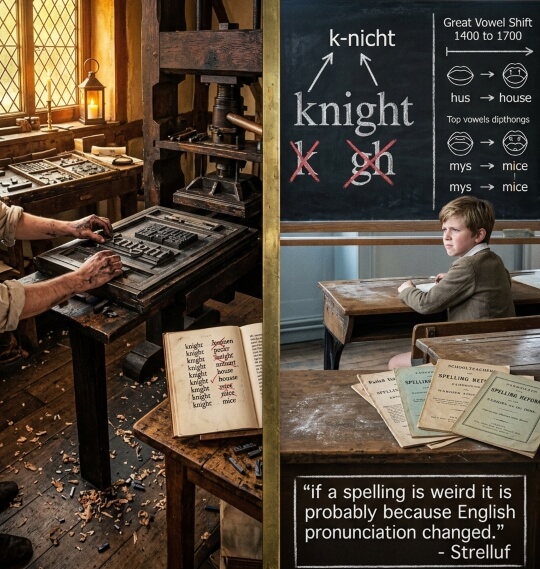
The word “knight” is the standard illustration. Before the Shift, the initial /k/ was pronounced and the gh represented a guttural consonant similar to the /x/ in “loch.” Both sounds were still present in Chaucer’s time. By Shakespeare’s, they were gone. The spelling, fixed in print, remained.
Spelling reform proposals appear periodically in English-speaking countries. None has succeeded. The obstacles are not primarily linguistic: they are economic and political. Any reform requires coordinated agreement across publishers, governments, educational systems, and the accumulated archive of existing printed material. The coordination cost has always exceeded any plausible benefit, and likely always will.
Etymology as a Method: How Word Origins Are Traced
Etymology reconstructs the history of words through documentary evidence, comparative linguistics, and the analysis of borrowing patterns across languages. It is a historical discipline: its conclusions are probabilistic and revisable, not provable in the way a mathematical proof is.
The Oxford English Dictionary is the primary source for the history of English words. Its stated aim, as set out in the 1933 edition, is “to present in alphabetical series the words that have formed the English vocabulary from the time of the earliest records down to the present day, with all the relevant facts concerning their form, sense-history, and etymology” (Encyclopædia Britannica). The project was proposed in 1857 by the Philological Society of London. The first fascicle appeared in February 1884. The final volume was published in April 1928: 71 years, 10 volumes, more than 400,000 entries, and nearly 2 million supporting quotations. It had been planned as a four-volume work to be completed within a decade.
The OED’s first edition etymologies reflected the state of scholarship at the time each fascicle was written – some entries dating from the 1880s. John Simpson, Chief Editor of the OED Third Edition, stated in his preface:
“The most significant changes relate to the analytical content of the revised etymologies, which for the most part update text which appeared in the First Edition of the Dictionary, and therefore represented the state of scholarly knowledge approximately one hundred years ago.”
— John Simpson, Chief Editor, Preface to the Third Edition of the OED, oed.com (2000)
The third edition revision began in 2000. By 2018, approximately half was complete. Some entries in the current online OED still carry first-edition text unrevised since the 1880s or 1890s. The OED acknowledges this openly.
Skeat’s Dictionary. What It Does and Doesn’t Cover
Walter Skeat compiled the Concise Etymological Dictionary of the English Language in 1882 largely without institutional support. He worked without the corpus-based tools now standard in lexicography. A revised edition appeared in 1910; the widely cited concise version was revised again in 1927. The dictionary remains in print and remains useful for 19th-century vocabulary and its Latin, French, and Germanic sources.
Its limitation is one shared by every foundational reference work: errors entered the secondary literature because later compilers cited Skeat rather than returning to primary sources. A documented pattern in etymology more broadly, and not unique to Skeat, is what one lexicographer has described as treating the OED as infallible:
“Because most so-called etymologists content themselves with copying what the OED states (as they consider it infallible), this has led to a phenomenon typical of folk etymologies, that is, stories fabricated in order to give a semblance of authenticity to erroneous theories.”
— Marcel Danesi, cited in wordhistories.net – “On errors in the Oxford English Dictionary” (2018)
The same circularity applies to Skeat. Later dictionaries that cited him without independent verification inherited whatever errors he had made. For 19th-century Germanic and Latin roots, Skeat’s dictionary remains a useful first reference. For anything requiring precision, or for words in the earlier sections of the alphabet where OED entries have not yet been revised, checking against the primary sources the OED itself cites is the more reliable approach.
Disclaimer: This page discusses linguistics and etymology for educational purposes. Peter Roach’s English Phonetics and Phonology (Cambridge University Press, 4th ed., 2009) is a copyrighted commercial publication currently in print. Skeat’s Concise Etymological Dictionary (1882) is in the public domain. The OED is a subscription service at oed.com. No links to unauthorised copies are provided or implied.