

Renaissance Philosophy, Syncretism, and the Mathematics of Descartes
How many philosophical traditions does it take to constitute a heresy? In 1486, Giovanni Pico della Mirandola found out. He was 23 years old. He published 900 philosophical theses drawn from Neoplatonism, Aristotelianism, Islamic philosophy, Jewish Kabbalism, Hermeticism, and Christian theology simultaneously, and invited every scholar in Europe to Rome to debate all of them in a single public session. Pope Innocent VIII appointed a commission. Thirteen theses were condemned as heretical. Six others were declared suspect. The public debate never took place.
This was not a fringe episode. Pico was the most famous philosopher of the Italian Renaissance, as Harvard University Press describes him in its edition of the Nine Hundred Conclusions (2023). His attempt to reconcile every major philosophical tradition into a unified account of truth sits at the centre of the 15th-century intellectual project, and it ended in condemnation, flight, arrest, and the eventual suppression of all 900 theses. The question his project raised, whether incompatible traditions can be reconciled, or whether the attempt itself is the problem, has not gone away.
Pico’s 900 Theses – What They Actually Said
The theses drew from a range of sources that had never before been assembled in a single document: Muslim philosophers including Ibn Rushd and Maimonides, Christian scholastics including Thomas Aquinas and Duns Scotus, Neoplatonist texts, Hermetic writings, and Kabbalist sources. Pico’s argument was not that these traditions agreed on everything. It was that each, examined carefully, pointed toward a single underlying truth. This was the intellectual position he called concordia, not compromise between systems but a deeper harmony beneath them.
“His boldest venture urged Christians to save their souls with Jewish mysticism, Kabbalah, while also offering to debate anyone in Italy about his project.”
— Harvard University Center for Italian Renaissance Studies, I Tatti, describing the Nine Hundred Conclusions
One of the specific theses that drew condemnation was directly theological: “A mortal sin of finite duration is not deserving of eternal but only of temporal punishment.” The Church read this as undermining the doctrine of Hell. Pope Innocent VIII’s bull of August 4, 1487, described the 900 theses collectively as “in part heretical, in part the flower of heresy; several are scandalous and offensive to pious ears; most do nothing but reproduce the errors of pagan philosophers, others are capable of inflaming the impertinence of the Jews.”
Pico wrote an Apologia defending the theses. The pope responded by condemning the Apologia as well. Pico fled to France, was arrested, and was released through the intervention of King Charles VIII. He returned to Florence under Lorenzo de’ Medici’s protection and died in 1494, aged 31, on the day Charles VIII entered Florence.
Syncretism as a Scholarly Method
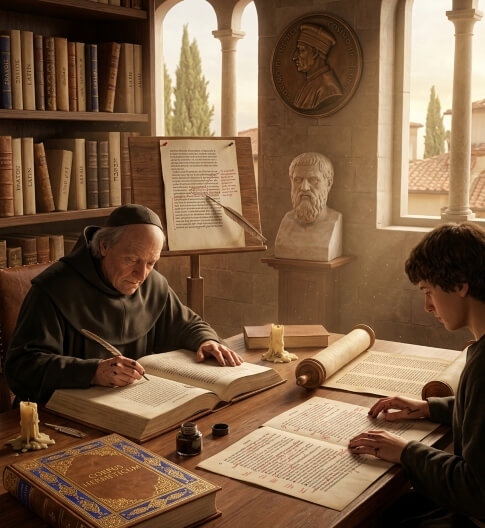
Syncretism, as an intellectual method, is the deliberate attempt to reconcile differing philosophical or theological systems by identifying shared underlying structures. Its institutional home in 15th-century Florence was the Platonic Academy, sponsored by Cosimo de’ Medici and led by Marsilio Ficino. Ficino translated the complete works of Plato into Latin, the first time this had been done, and also translated the Corpus Hermeticum, a collection of Greco-Egyptian philosophical texts he believed to be older than Moses.
Pico was Ficino’s student and his successor in ambition. Where Ficino synthesised Platonism and Christianity, Pico extended the synthesis to include Kabbalism, a move that made him the first Christian scholar to use Kabbalistic doctrine in support of Christian theology, as Britannica notes. His access to Kabbalistic texts, however, came almost entirely through a single source: Flavius Mithridates, a Jewish convert who produced Latin translations of Kabbalist works specifically for Pico. Subsequent scholars have found that these translations contain significant interpolations – additions and modifications that were not in the original Hebrew texts. How much of what Pico understood as Kabbalism was actually the tradition, and how much was Mithridates’ editorial judgement, is not fully resolved.
Descartes’s Private Notebook
In 1619, René Descartes, 27 years before he published Meditations on First Philosophy, kept a private notebook he called Cogitationes privatae (Private Reflections). The notebook, which dates from approximately 1619–1620, was found among his papers after his death in 1650. What happened to it next is the problem.
Leibniz visited Paris in 1676 and was allowed access to Descartes’ papers by Claude Clerselier, who held them. According to the Cambridge Descartes Lexicon (Cambridge University Press, 2015), Leibniz made his copies of the Cogitationes privatae on or around June 5, 1676. The original notebook subsequently disappeared. What survives is Leibniz’s copy.
The Cambridge Descartes Lexicon records that the mathematical passages Leibniz copied from the notebook contain descriptions of “new compasses” Descartes had devised for trisecting angles and finding mean proportionals, as well as sketches of instruments for solving cubic equations. The notebook also included pages in code. The New Atlantis (2007) notes that the code “was only broken in the 1980s by a French scholar” and was thought to be Rosicrucian in origin.
— Cambridge Descartes Lexicon (CUP, 2015); The New Atlantis review of Aczel (2007)
Amir Aczel’s Descartes’s Secret Notebook (2005) argues that the Rosicrucian connections were substantial and that they shaped Descartes’ mathematical development. Academic historians have found the account of the mathematics persuasive and the mystical interpretation overstated. The notebook was the product of a young mathematician in a period when the boundary between systematic inquiry and esoteric symbolism was not yet fixed, which is precisely what makes it interesting.
How Renaissance Scholars Read Ancient Sources
In 1460, a Macedonian monastery manuscript arrived in Florence. It was a Greek text attributed to Hermes Trismegistus, a mythological figure identified with the Egyptian god Thoth. Cosimo de’ Medici instructed Ficino to set aside his Plato translation and translate the text immediately. Ficino did so; his Latin translation was published in 1471. It was read throughout Europe. The premise underpinning its authority was that it predated Plato and Moses.
In 1614, Isaac Casaubon published De rebus sacris et ecclesiasticis exercitationes XVI in London. His method was philological. He examined the vocabulary of the Corpus Hermeticum and found terms – Demiurge, Ogdoad, Nous, Logos – that were characteristic of Hellenistic Greek, not ancient Egypt. His conclusion located the texts between 200 and 300 AD. Wikipedia notes that his analysis “overturned the previous general opinion in Europe that these texts dated from almost the time of Moses.” By the end of the 17th century, most scholars had accepted Casaubon’s dating.
The influence of the Corpus Hermeticum did not end with Casaubon’s refutation. Hermetic ideas had been absorbed into a century and a half of natural philosophy, magic, and early scientific thinking. Frances Yates’ Giordano Bruno and the Hermetic Tradition (1964) argued that Hermetic thought was not an obstacle to the Scientific Revolution but part of its intellectual preparation. That argument remains contested, but the persistence of Hermeticism after its historical basis was demolished is itself a datum worth noting.
George Carey’s God Man: The Word Made Flesh (1920) is one such datum. Carey reinterpreted the Hermetic numerological tradition as a physiological system, arguing that astrological cycles correspond to biochemical processes in the human body. The book draws on Kabbalist and Hermetic number symbolism, the same tradition Ficino introduced to Florence and Casaubon dated to the 2nd century AD, but transposes it into a register that combines popular physiology with astrological allegory. It is not a work of Renaissance scholarship. It belongs to the trajectory of an idea whose scholarly basis had been refuted three centuries earlier and whose popular appeal did not depend on that basis.
Where Theological and Mathematical Thought Intersected
The intersection of mathematics and theology in the 15th–17th centuries was not ornamental. Johannes Kepler’s Harmonices Mundi (1619), the same year Descartes began his private notebook, argued that the ratios between planetary orbital speeds corresponded to musical intervals. Kepler identified the proportions and believed they reflected divine design. The third law of planetary motion, which he discovered in the same work, emerged from this project. The mathematics was correct. The theological interpretation was separable from it, but Kepler did not separate them.
Kabbalist practice had always assigned numerical value to Hebrew letters, treating the relationships between numbers as channels of theological significance. Scholastic theologians at Paris and Oxford used geometric demonstrations to argue points of theology, extending the methods of Euclid into questions of divine attributes. Pico’s project to reconcile these traditions was not an eccentric sideshow: it reflected the actual structure of Renaissance learning, in which theology, mathematics, and natural philosophy had not yet organised themselves into separate disciplines.
When and how that separation occurred is a genuine historical question without a clean answer. The standard narrative centres on the 17th century – Galileo, Descartes, Newton – as the point at which mathematical description of nature was systematically decoupled from theological interpretation. But Kepler wrote the third law of planetary motion in the same text as his harmonic theology. Newton spent more time on biblical chronology than on physics. The separation was slower, messier, and more contested than the tidy sequence suggests.